Monday, May 10, 2010

:O Last blog post!


So hard to believe that this is the last one... it seems like the year just began, and all of a sudden the exams are upon us. ><><). The point where the graph passes the x axis, where the preparedness is zero, is the point when I walked into the physics room right before the multiple choice part of the exam, and realized that I didn't know anything. The most negative point was the end of the multiple choice exam. :P Right now, I'm feeling pretty good about the exam... but since it's a wave I'll likely feel really unprepared in half of a wavelength. Since I went through one wavelength in about a week (from the point I started studying to the point when I was done with the free response), I estimate that if the frequency stays the same then I'll be really depressed in about half a week... But I think the frequency is increasing since the AP exam is tomorrow... *panics* The amplitude of the wave is the range from very prepared to negative preparation...

This course was fun, overall... if you enjoy pain. (Just joking. ;) ) I feel like maybe I should have written a serious last post, but that's ok... *points to above picture* although I may have gained many things through physics, paint skills aren't any of them...

Still though... only two days of physics left... :D

Sunday, May 2, 2010

Cheepcheepcheeeeeeep


Nooooo... I just wrote a whole blog entry and then firefox froze on me... :( I get to write it again...
This cute little chick you see here (yes, he's cute, even though you can't see his eyes because he's unnaturally fluffy; if he was real, this might be a problem) is my brother's toy. He has two little metal contacts on the bottom. If you touch only one, nothing happens, but if you touch both, the little chick goes cheeep. Interestingly, if you touch one, get a friend to touch the other one, and touch your friend, it also goes cheep. This is because either way, you're completing a circuit. There are batteries inside the chick that provide a potential difference; here we'll assume that there are 3 button cell batteries, each with a voltage of 3 volts. They are connected in series, so you add their voltage, giving the circuit a total potential difference of 9 volts. If you pretend the speaker and circuit board have a resistance of 3 ohms, then you can calculate the current using V = IR as 3 amperes.
Ignore the fact that I took the picture of the chick on my brother's lap desk... :P

Sunday, April 25, 2010

Washing Cups


Only... two more blogs left? *cries* How is this possible?!?! I feel like I have to think of some really awesome blog topic to sum up the year, but all I could think of was cups...

A few days ago, I was washing dishes in hot water and soap. I like to stack them in the sink, especially the cups, after I get them all sudsy. :P However, when I began to rinse them out, I realized I couldn't separate two of the cups. THEY WERE STUCK. O_o. Frantically, I tried to pull them apart, but to no avail... the cups won the battle. Defeated, I left them in the sink (like a coward) for my dad to deal with when he got home.
Later, when he came home, he asked me why I'd left two cups in the sink. He seemed puzzled when I said that I couldn't separate them, because he said that he'd simply pulled them apart.
There were two solutions to this mystery. One was that I was just extremely weak, and the other, slightly more probable one was... PHYSICS! (The answer to everything!)

When I washed the two cups with hot water, they heated up and expanded. However, the inner cup was hotter than the outer one, because I washed it later, and then the outer cup acted as an insulator, keeping the heat in. The outer cup was constantly splashed with colder water as I rinsed the other dishes, cooling it. This means the inner cup expanded more than the outer one, and got stuck inside. The surfaces were then so close together that the static friction force was greater than the force of me pulling them apart. When the cups cooled down again, as they had by the time my dad came home, they were back to their normal sizes and were easy to separate.

Monday, April 19, 2010

Random Pop Gun Thing

Yes, a very creative title, I know... Sadness... only a few blogs left... *sniff*
So on Friday, while carrying my brother's various prizes while he bounced maniacally in a bounce house at the fair, Bean and I discovered the massive fun involved in this particular little toy. Who would have thought it would be so addicting? :P The gun works because of pressure, and also exhibits projectile motion of a sort, so naturally the first thing I thought of was physics...
To "load" the gun, you pull back on the handle, which applies a tension force on a string and causes a net force which equals ma (mass of the cork * acceleration) to accelerate and wedge itself into the hole at the end of the gun. When the handle is quickly pushed together again, the volume rapidly decreases, and using the rule PV = nRT, since the number of moles, temperature, and constant R stay constant, when V decreases, P must increase. Finally, the P increases enough that this force overcomes the static friction between the cork and the edges of the hole at the end of the gun. When this happens, the cork flies out, increasing the volume and decreasing the pressure. The cork then follows projectile motion, continuing with constant X velocity (assuming no significant air resistance) and accelerating downward at a rate of 9.8 m/s^2, until it reaches the end of the string and is yanked back by the tension and falls. The cork then hangs at equilibrium, with it's mass balanced by the tension in the string.

I've just noticed that the little kid in the video seems to be mesmerized by Bean repeatedly popping the pop gun... XD

Sunday, April 11, 2010

Wireless Router

On Friday, I helped fix the robot which had been unfortunately broken by some overethusiastic robot *coughwaialuacough*.  However, that's not what I'm talking about in this blog.

As we tested the robot and drove it around, we used a wireless router, shown above, to connect the driver's station computer to the robot wirelessly.  There was a router attached to the driver station, and an antenna receiver on the robot itself which was connected to the CRio, the onboard computer on the robot.  The robots use WiFi to communicate, which uses 2.5 gigahertz frequency electromagnetic waves.  If you use the equation c=lambda*f, you can calculate the wavelength of the WiFi as 0.12 m.  This means the WiFi can fit through pretty small gaps and this explains how you can get WiFi signal from pretty far away.  However, over a long distance the protons experience scattering.


Friday, April 2, 2010

FRC Robotics!

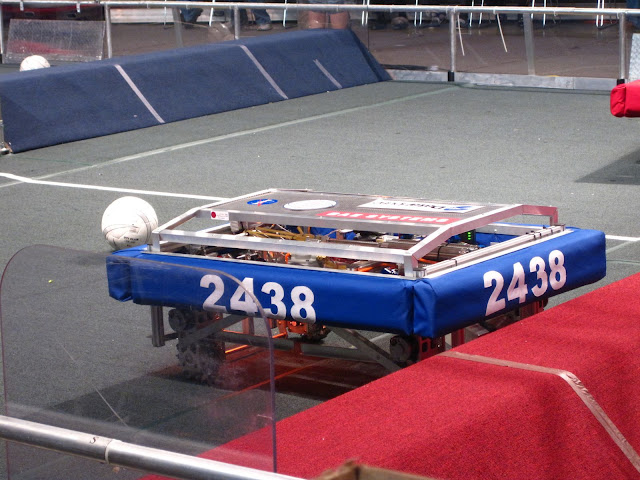
Last weekend, I was at the FRC (FIRST Robotics Competition) at Stan Sheriff Center. Our team, 2438, did pretty well, and ended up in the finals, and although we didn't win, we got eliminated after losing to the winning alliance.
Here is our robot.Credit to Lauren Faris who was doing field reset stuffs, so she was close enough to take decent pictures.
Pretty! Shiny! (This is sounding strangely like Vicky, so I'll stop now...)

Obviously a lot of physics (and fun) is involved in building a big metal hundred pound robot. The part that I'll focus on today (so that I can stretch out robotics over several different blogs) is the balance of the robot. It's really important that the center of mass be as close to the center of the robot as possible, so that our robot is stable and will not flip over. As proof of the skillfulness of this, our robot was never flipped in a match, as many others were. While building and designing, we occasionally checked to see if there was more weight (mg!) in the front or back of the robot. When we tried to figure out where the battery should be placed, we balanced the robot on something to see if it wanted to tip further forward or back. Eventually we decided to mount the battery straps in the back to balance out the weight of the kicker in the front. Our robot was also low to the ground, and this meant that the center of mass was lower and so the robot wanted to stay in static equilibrium.

Friday, March 19, 2010

My glasses


I'm nearsighted, or myopic, so I have to wear either glasses or contacts. This means that my eyes can only focus on nearer objects and not farther ones. The lenses in my eyes are not able to focus the image on the retina, at the back of my eyes, because the eye is too long. The lenses in my glasses are diverging lenses, which spread out the light so that my eyes can focus the light on the back of the eye.

When you look at the glasses closely, you can also see the way the image through the glasses is not in focus in the camera and the image does not quite line up with the rest of the page of writing. This is because of the refraction caused by the glass, and the lens is also acting to make the image seem a little smaller.

Saturday, March 13, 2010

Rainbows!

Yesterday, I found this prismy thing by the back door. It's supposed to be hung in a window, and make rainbows.
With help from my parents to hold the flashlight, I got lots of pretty pictures of rainbows. :P The prism is acting as a lens, and refracting the light through dispersion. Since the n value of the glass is different from that of the air, the light will refract and chromatically disperse. Different wavelengths refract differently, so we see a rainbow of colors from the white light of the flashlight.
Pretty colors!

Sunday, March 7, 2010

Ice skating

Ok, since I forgot/weren't allowed to take pictures on the ice, I'll have to make do with the one from the Ice Palace website... :P

Like a typical physics student, the first thing that came to mind when I was attempting to skate was that ice is an almost completely frictionless surface. This means that you can glide for a long time on ice because almost all of the energy remains kinetic energy and isn't converted to heat or potential energy (don't ask me where the potential energy would go...). A force must be applied by the skater to get moving at all, and so you need to provide a force forward by pushing with your feet. When the skate is pointing in the direction of it's velocity, the friction coefficient and friction force is very low, while when the skate is pointing perpendicular to the velocity the friction force is very high. When skating, you can take advantage of this friction by pushing yourself forward with your skate sideways so you can have more traction to push yourself forward. Another important part of skating is balance, so your center of mass must be directly above your skate blade or you will fall over. Also, if you stop suddenly (say, someone skates right in front of you, and you don't want to hit them) by digging in your toe pick to increase the friction, although there is a negative acceleration on the skates, the rest of your body is still moving at a constant velocity, and you will often tip forward just enough so your center of mass is no longer above your skates, and you lose your balance.

Wow, that was a long blog... :)

Saturday, February 27, 2010

Induction chargers


My brother has a little blue creature that glows, and you charge it by placing it on the little charging dock. I always wondered how this worked, since there are no plugs or contacts that connect the charging platform to the light. Now I know that it works through inducted current! The dock probably uses some kind of solenoid and the current from the outlet that it's plugged into to make a magnetic field. The outlet is 120 volts, and the potential difference in the charger itself is probably different, so this means that there are probably two solenoids forming a transformer. The magnetic field formed by the current flowing through the wires in the charger affects the circuit in the light itself and causes it to have a current flowing through it. Since the light charges, though, and doesn't go off as soon as it leaves the charger, some kind of capacitor or rechargable battery must also be part of the circuit so that it can store the charge for later use.

Sunday, February 21, 2010

Circuit breaker!


This is the main breaker for the FRC robot! (Robotics is very useful for physics blogs..)
We use it for the on/off switch on the robot, but it's mainly meant to keep too much current from flowing through the circuit. If there is too much, the breaker heats up and switches the robot off. The little black part clicks out. To turn it back on (hopefully after you removed some of the motors and other things that are causing resistance) you click the black back in. Normally to turn off the robot you push the red button.

Naturally, you want to mount this breaker where it won't be hit by an errant ball, or your robot would randomly go dead, since the circuit would be broken and no current provided to the motors, speed controllers, and other parts.

I'm not sure why the picture has decided to be upside down, but I'm too lazy to fix it. :P The limit on this breaker is 120 amperes, so if it exceeds this limit the breaker will turn off.

On a random note... yay for working on robotics for over 9 hours straight and leaving school at 12:30 am!!!!

Whee...

Saturday, February 6, 2010

Light bulbs!


In my bedroom, the lights in the fan are still normal incandescent light bulbs, rather than florescent. This is because the lights in my room can dim, and most florescent bulbs can't dim. As you can see, the filament is visible. Power = I * delta V, and also = delta V^2/R. The power that is lost can be calculated, if you knew the resistance of the material of the filament. The change in voltage is the same as the voltage of the light bulb, or 40 watts. This loss of power as the current passes through the wire is the energy that becomes the light that we see. This is why a light bulb with a higher voltage, such as 60 watts, is brighter, since the voltage is higher and the power lost will also be higher.

Friday, January 29, 2010

A dangerous magnetic object!


Sorry, you'll have to deal with my fail paint skills this week since I totally forgot to take the picture I was intending to take...

This rather intimidating, scary thing is actually a collector for pins and needles and the like. No, it's not mine. Yes, it exists in real life. Yes, someone needs to buy this person a REAL pincushion. In any case, it clearly demonstrates electric fields. The magnetic pin cushion keeps the metal pins and needles from escaping. They must have opposite charges, and therefore create a force equal to E*q, or the measurement of the electric field times the charge of the needle. Luckily, this force is greater than the weight force of the needles, or they would all go clattering to the floor in a dangerous mess. Unfortunately most of the needles and pins here are rusty and leave strange rust marks on the fabric when you use them...

Ten points to anyone who can guess the rather odd place where this is from... It's not anywhere that you would expect. :P

Whee for lots and lots and lots and lots and lots of random sewing... 2 done, 30 to go in a week...

Sunday, January 24, 2010

A cabinet door


On the cabinet in my bathroom, a magnet holds the door closed. This means that one side (maybe the door) has a strong negative charge and the other side (maybe the cabinet itself) has a strong positive charge, so there is a force that pulls each toward each other. The hinge, however, creates a force that wants to force the two apart. If the electric force of the door magnet and cabinet magnet is not greater than the spring-like force of the hinge, then the door will not stay closed. The electric force of the two magnets can be calculated using the equation F = k(charge of door)(charge of cabinet)/the distance between the two ^2. This means that the force is constantly changing, increasing as the door swings more closed and decreasing as the door swings more open. The spring force of the hinge decreases as the door swings open, and increases as the door swings open. Unfortunately, we don't have any way to measure the charge of the door magnet and the charge of the magnet on the cabinet, so I don't have to do the calculation....

The door doesn't stay closed, as you can see in this picture, so the magnets are too weak for the electric force to overcome the force of the hinge. Cabinet = fail.... :P

Friday, January 15, 2010

Bouncy Ball


At the robotics sleepover last weekend, we started playing with a super bouncy ball. Apparently you can throw it around 25 feet or more up if you throw it at the ground really hard. Since I was weak, I could could only get it 15 feet or so, but the first thing that this made me think of was conservation of energy. (Yes, I know, physics geek. :P)

Since the ball bounces really high, most of the energy of me throwing the ball downwards must go back into the ball as it bounces back up. For most balls, the kinetic energy of throwing the ball goes into sound or other forms of energy when it hits the ground, but for this ball most of the energy must go into potential energy and then kinetic energy. If you calculate that the ball goes 25 feet up, since the acceleration of gravity is -9.8 m/s^2, the velocity of the ball at the bottom was 22.1 m/s. This means that it's initial KE was 1/2mv^2, so if you pretend that the ball was 0.2 kg, then the KE is equal to 98 J. At it's highest point, the PE must be near 98 J, and most of it must not be lost if it goes so high on the next bounce.

Sunday, January 10, 2010

Ripples


Last week, a bunch of my friends from robotics slept over at Emily's house, which is really close to the water of Pearl Harbor on Ford Island. Two of us couldn't sleep, so we ventured outside at 5 in the morning to watch the sunrise, though because of a combination of sleep deprivation and laziness I didn't pull out my phone to take a picture of it. It was cool, even if we were facing the wrong direction to see the Arizona memorial or the sunrise. As the sky gradually got lighter, I could see the ripples on the water, which was about 10 feet away . Suddenly, a small speed boat went by. A minute later, we heard a strange sloshing noise.

It took a couple of seconds for us to figure out that the sound was the waves made by the speed boat, although the boat had passed into the distance a while ago. The waves reached us so much after the sound and sight of the boat had passed because the wavespeed of the sound and of the light that allows us to see the boat was so much greater than the wave speed of the waves. However the amplitude and wavelength of the waves was much greater than that of the sounds. When the waves hit the shore, the energy of the waves changed to kinetic energy as the pebbles on the beach slide back and forth, and the collisions between the pebbles caused energy in the form of sound waves to be made.

I didn't take a picture, so we'll have to deal with google ones for now... :P Though this is pretty close to what it looked like.

Friday, January 1, 2010

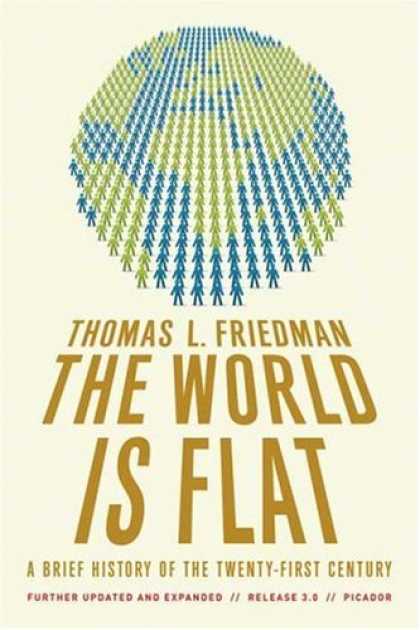
Personal Response on The World Is Flat: A Brief History of the Twenty-First Century by Thomas L. Friedman


Frankly, the book The World Is Flat by Thomas L. Friedman was by far not the most interesting book that I have ever read. However, it may have been one of the most truly educational and relevant things that I have ever read for school. When I first read the title, The World is Flat, I couldn’t imagine what this meant. I now understand that the author isn’t ignorant of simple scientific principle like I originally thought, but using a metaphor to talk about the way that new opportunities for global collaboration are being opened to everyone.

I actually found this book enlightening and depressing at the same time. Friedman was saying that my generation will not have the ease of finding jobs that our fathers and grandfathers did, because of increased competition from India, China, and other developing countries. New jobs are being created, but we must work harder to get an education and continue to learn ways to be not simply “vanilla,” as Friedman puts it, but a cherry on the top of the sundae. We must be something that is special and valued, not something that can be outsourced to other countries, and create niches for ourselves. When Friedman made the example of the private school where international parents complain there isn’t enough homework, and white middle class American parents complain that there is too much, I thought of ‘Iolani. Would the standards at our school really stand up at an international level? Are we, as students, really prepared to be competing on an international level?

Even many of the students at our school are not actually American citizens. Instead, they come here (with or without their parents) to get a better education and, their parents hope, a better life. I’ve clearly seen the cultural differences that Friedman mentions between first generation immigrant families and the more relaxed third or fourth generation American families. The new immigrants seem to be more involved in their children’s lives, and more likely to encourage them to get straight A’s and aspire to become doctors or lawyers.

This book has definitely changed the way I think, even if I had to slog through it by forcing myself to read it page by page. When I visited Costco with my family, I thought about how all the different products go through a national supply chain to be shipped here. When I went to Walmart, I resisted the urge to inspect the pallets of unopened boxes for those RFID tags that Friedman mentioned, and wondered as I went through the checkout if right at that moment the producers of fish food and flour were rushing new shipments to the warehouses to replace the ones I was taking with me. I wondered if the benefits that Costco workers gain are better than the financial benefits that Walmart as a company enjoys. Even in the McDonald’s drive-through, I began to see signs of outsourcing. Often, the person you speak to when you order at the drive-through isn’t in the McDonalds at all. Instead it is someone on the mainland who takes your order, then sends it electronically to the window where you can pick it up minutes later.

This book is long, with so many examples and references that I felt that the author must be repeating himself. I can’t really see anyone reading this for fun, though, and I’m not sure how much the content will really help readers. It is educational, and shows you how the world is widening and becoming more equal in most places, but even the author doesn’t know the secret to success or even survival in this new world of Globalization 3.0. His best advice is to simply continue to learn and change as the world changes around you. He doesn’t think that globalization should or can be stopped, but that we must adapt to it and continue to succeed as a country. I just hope I have enough ambition and eagerness to learn that I can survive in this new, flat world.